
Conductors: Elgar Howarth; Lionel Friend
Trumpets: Philip Jones, Rod Franks, Nigel Gomm, Joe Atkins, James Watson
Trombones: Roger Harvey, Christopher Mowat, David Purser, Raymond Premru
Horn: Frank Lloyd
Tuba: John Fletcher
Chandos Recording: ABRD 1190
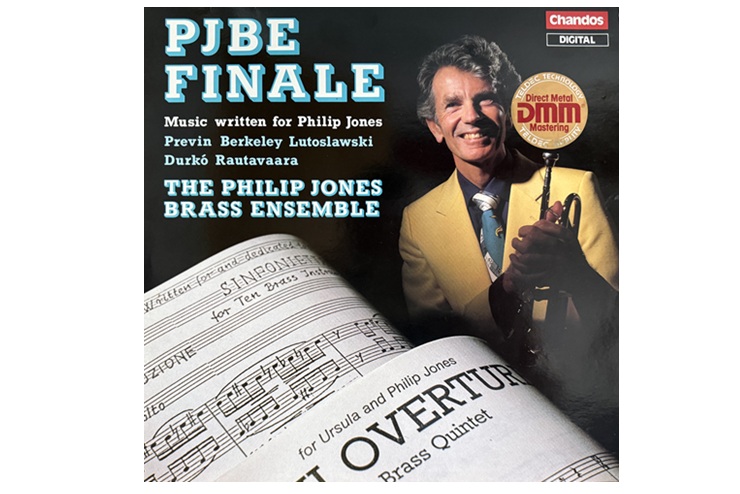
Just over 40 years (8th June 1986) the Philip Jones Brass Ensemble gave its last public performance.
Held at Queen Elizabeth Hall in London it came a few days after this recording was made at St Luke’s Church in Hampstead, produced by the acclaimed team of Brian, Ralph and Philip Couzens.
As a curtain call, the ensemble (formed in 1951 as a quartet, eventually becoming a 10-piece in 1974) left the stage still at the peak of their musical powers, their legacy of nearly 400 works (87 world premieres) drawn from an incredibly wide seam of inspiration.
Gold standard
They remain the ‘gold standard’ of comparative measurement for those who followed in their wake, starting soon after with the formation of London Brass made up of a number of former members.
They remain the ‘gold standard’ of comparative measurement for those who followed in their wake
Today, the PJBE International Brass Ensemble Competition, founded by his equally inspirational widow, Ursula Jones OBE, is arguably the most important event for emerging performers in the world, its latest edition won by the IYOKO Ensemble from Spain.
Last chapter
For this ‘Finale’ recording the repertoire was written for its founder (1928-2000) in the five-year period leading up to their final concert appearance. It is an impressive last chapter of contributors: Andre Previn (1929-2019), Michael Berkeley, Witold Lutoslawski (1913-1994), Zsolt Durko (1934-1997) and Einojuhani Rautavaara (1928-2016).
The same can also be said of the performers and conductors, although sadly, Howarth, Jones, Franks, Gomm, Watson, Premru and Fletcher are also no longer with us.
Acerbic
Previn’s ‘Triolet for Brass’, is a clever, acerbic suite of eight movements linked in personal inspiration to poetic structure - one where a stanza of eight lines sees the first matching the fourth and seventh, the second to the eighth.
Perhaps due to the love shown for his new son, Lukas, it is subtly proportioned in character and style
Written in December 1984 between tenures at the Pittsburgh and Los Angeles Philharmonic Orchestras, it is an uplifting work even in reflection.
Perhaps due to the love shown for his new son, Lukas (affectionately called ‘Chubbs’ and described in a New York Times interview in 1986, as someone “I would rather spend time with than do anything else”), it is subtly proportioned in character and style – from the ‘Opening’ with chord structures reminiscent of McCabe’s ‘Cloudcatcher Fells’, to its jazz inflections, and innocent ‘bouncing’ fun of the finale.
Poetic development
Michael Berkeley’s ‘Music from Chaucer’ is also a poetic development, although of incidental music for a BBC Radio 3 series. It has both a bawdy wit and touching beauty in its five movements – from the ‘vile brass’ of ‘Triton’s Trumpets’ emanating from ‘the devil’s arse’, to a simple setting of ‘The Wakeful Poet’ to close.
It has both a bawdy wit and touching beauty in its five movements – from the ‘vile brass’ of ‘Triton’s Trumpets’ emanating from ‘the devil’s arse’, to a simple setting of ‘The Wakeful Poet’ to close.
Two substantive works of serious intent form the basis of Side 2, although Lutoslawski’s ‘Mini Overture’ is a gem of imaginative brevity.
Written as a 50th birthday present for Ursula Jones following a request to her father, it almost never arrived due to the escalating political strife in Poland at the time. Thankfully, when hope was all but lost, the family was informed that a battered parcel was waiting to be collected at the Polish Embassy in London – in it the handwritten parts and score.
Evocative listening
Premiered in 1985, Durko’s ‘Sinfonietta’ has since become a staple of the brass ensemble repertoire – the short, preparatory opening leading into a coloured secondary exploration, a motivic third and harmonic fourth before a trumpet led finale and imitative codetta.
So too Rautavaara’s fascinating ‘Playgrounds for Angels’ (1981), an extended canzon per sonar sound palette that draws you into a deeply evocative listening experience from contrapuntal playfulness to dense, almost impenetrable chordal blocks of seamless sound.
Iwan Fox
Play list:
Side 1:
1. Triolet for Brass (Andre Previn)
i. Opening
ii. Very Still
iii. Fanfare
iv. Waltz
v. Interlude I
vi. Interlude II
vii. From a Distance
viii. Chubbs
2. Music from Chaucer (Michael Berkeley)
i. Triton’s Trumpets
ii. The Grieving Queen
iii. A Fanfare for the Huntsman
iv. The Sorrowful Knight
v. The Wakeful Poet
Side 2:
1. Mini Overture (Witold Lutoslawski)
2. Sinfonietta (Zsolt Durko)
i. Introduzione: Allegro molto
ii. Canone alla prima: Andante
iii. Prestissimo, tutti con sordino
iv. Developments: Andante
v. Double: Piu sostenuto
3. Playgrounds for Angels (Einojuhani Rautavaara)