
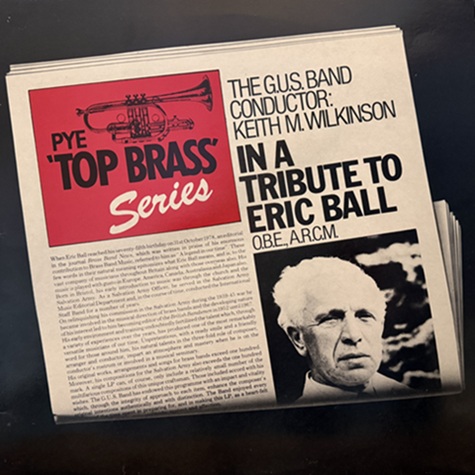
The GUS Band
Conductor: Keith M Wilkinson
Pye Records: Top Brass Series - TB 3021
Recorded four years after his final, original test-piece, ‘Sinfonietta - The Wayfarer’ was used at the Royal Albert Hall in 1976, Eric Ball remained the enduring compositional influence on the mainstream banding movement.
Although a new generation led by Edward Gregson and the emerging talents of Philip Sparke had made their mark, his works still held sway at all levels of contesting.
Even today, 36 years since his death, his compositions retain a pertinence that the current banding movement would do well to fully re-evaluate, rather than pay occasional lip-service to.
In a survey undertaken by British Bandsman in 1990, he still clearly emerged as respondents ‘favourite’ composer, whilst ‘Resurgam’ (1950) and ‘Journey into Freedom’ (1967) were voted as two of the most popular works for the medium.
Even today, 36 years since his death, his compositions retain a pertinence that the current banding movement would do well to fully re-evaluate, rather than pay occasional lip-service to.
This recording could help in the process.
Musically astute
The GUS Band was no longer the pre-eminent contesting outfit it had been when Ball’s ‘High Peak’ brought the 1960s to an end, but a decade or so later they were still a highly accomplished elite contender, experienced and musically astute.
Under Keith Wilkinson they were 1980 Midlands Regional Champion, runner-up at the British Open (on ‘Energy’) and winners of a high-quality Wembley Contest and the BBC ‘Best of Brass’ title.
The MD had Eric Ball in his blood. A salvationist who balanced a passionate understanding of the music with the clarity of a mathematician’s thinking
The MD had Eric Ball in his blood. A salvationist who balanced a passionate understanding of the music with the clarity of a mathematician’s thinking, the recording showcases both aspects in a series of nuanced performances, even if the working out is prone to occasional scruffiness.
‘Festival Music’, (1956) is a piece of almost perfect, pastiche academic rigour – displayed in form and function with a bright, lightness of touch without recourse to implausible interpretation. The same applies to ‘Resurgam’ – moulded with respectful consideration to the composer’s intentions.
Eyebrow raiser
‘Fantasy: The English Maiden’, written in 1948, but used just once at a contest since 1966, is a work that both stylistically and with a view to wider considerations (although the sleeve note still raises an eyebrow in describing it as, “in praise of the fairer sex”) could well have been a better choice than ‘Indian Summer’ for this year’s Fourth Section Regional Championships.
It has certainly aged better in outlook than many others of the same vintage.
‘Free Fantasia’, which is a seriously crafted gem of the compositional art of the miniaturist
Further evidence of era-crossing appeal lies in the opening ‘Symphonic March: October Festival’ (1978) with its deliberate Elgarian thread of acknowledgement, whilst ‘Festival Prelude from fantasia Celebration’ (1971) is his own orcheatral brass arrangement that seems to connect the imperial march influences of John Williams and William Walton.
Elsewhere, ‘Spring Humoreske’ is a little bit of alpine-esque whimsey – clever and joyful, that sits neatly in contrast to ‘Free Fantasia’. It is a seriously crafted gem of the compositional art of the miniaturist developed from kernal of an idea that came to mind when walking past a London hospital.
Ball described it as “one of his favourites”. His skill commands everything in its containment.
Iwan Fox
Play list:
Side 1:
1. Symphonic March: October Festival
2. Free Fantasia
3. Festival Music
i. Overture
ii. Romance
iii. Impromptu
Side 2:
1. Festival Prelude from fantasia Celebration
2. Fantasy: The English Maiden
3. Spring Humoreske from Three Songs without Words
4. Resurgam