
St Magnus Festival
Harray Community Hall, West Mainland
Saturday 27th June

A good-sized audience including members of the late John Wallace’s family was in attendance for The Wallace Collection’s morning concert of music by Joseph Haydn and Auguste Mimart, played on 19th century period instruments. Sandy Coffin, who discovered the Haydn transcriptions in the French National Library, was also present.
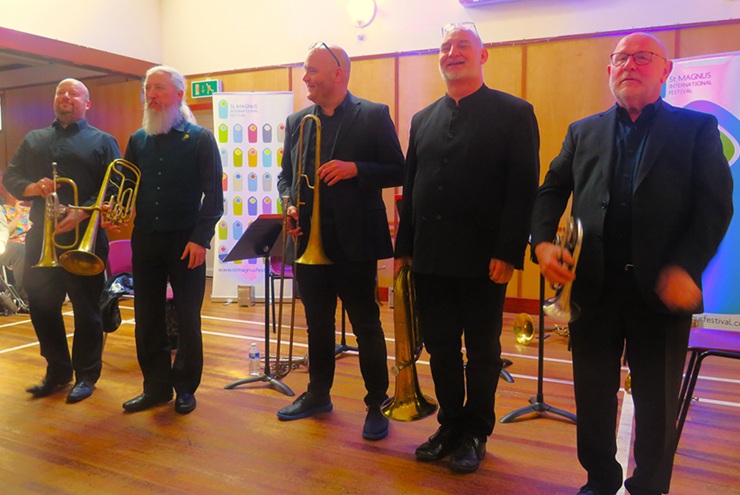
Alistair Douglas and John Miller played a variety of cornets and valved bugles, Fergus Kerr performed on alto saxotromba, Paul Stone doubled on baritone saxotromba and trombone, and Tony George switched between ophicleide and a six-valve basse.
Skilful
The intonation of these old instruments is not quite as reliable as that afforded by their modern equivalents, and from time to time we could hear notes being wrestled into tune by these skilful musicians. A good deal of alternative fingering was also on display.
The programme included two transcriptions by Julien Tollot of string quartets by Haydn. The trills and grace notes which ornament ‘Opus 33, No. 3’ have been likened to avian song, leading to the work being nicknamed ‘The Bird’. Listening to this fine performance, you could almost believe that it had been written originally for brass.
Listening to this fine performance, you could almost believe that it had been written originally for brass.
‘Opus 50, No. 5’ – ‘The Dream’ featured a graceful minuet and a rollicking finale which bounced along merrily. As with ‘The Bird’, it is so-called because its poco adagio movement is considered to have a dreamlike quality. The application of nicknames to so many of Haydn’s string quartets and symphonies was the work of other people, some of whom, one feels, must have had fairly broad imaginations!
Pleasant interlude
Haydn’s version of ‘The Bluebells of Scotland’ was originally a vocal work in which the accompaniment varied with each verse of the song.
John Miller’s arrangement saw instruments of the quintet play the vocal line with the work taking on the nature of a set of subtle variations.
John Miller’s arrangement saw instruments of the quintet play the vocal line with the work taking on the nature of a set of subtle variations. Without the words the piece seemed to lack a little focus, but it was a pleasant interlude between the two larger works in what was, after all, a Scottish festival.
Humour
In between the musical items, each of the quintet’s members took it in turn to talk about the music and instruments, each cameo laced with a liberal dose of humour.
The concert closed with Auguste Mimart’s ‘Quintette No. 5’, a brisk and jolly affair in the style of an operatic overture, featuring exciting flurries of semiquavers and some agile triple-tongued arpeggios in the lower register by Tony George on the basse.
The audience would not let the group go without an encore and they returned to reprise the last three minutes of the Mimart, this time taking one or two liberties with the music and generally having fun. As did we all.
Alec Gallagher