
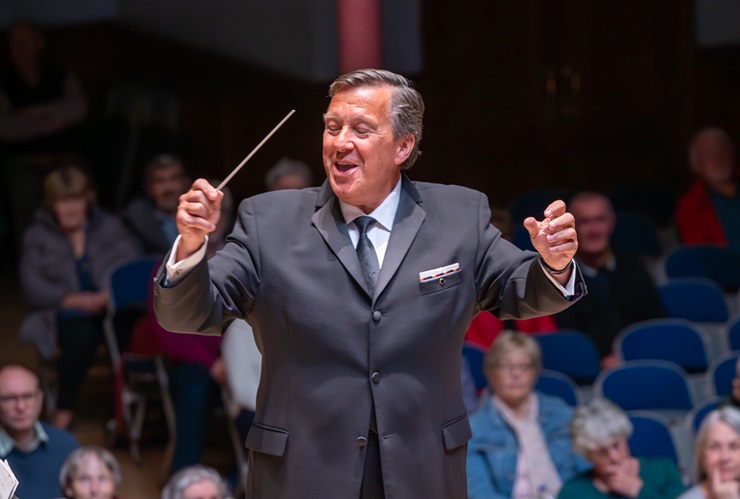
Conductor: Prof Nicholas Childs
Soloist: Tom Hutchinson
Elgar International Festival of Brass
The Bradshaw Hall
Royal Birmingham Conservatoire
Sunday 7th June

Philip Sparke’s connection to the brass band movement began in answering a publisher’s advert posted on a notice board at the Royal College of Music in 1974.
In reply he wrote ‘Concert Prelude’, a work whose 4-minute structure contains the essential DNA that has underpinned his subsequent output for the medium. It is a perfect exemplar of compact modal form and function, one that in an age of youthful compositional obesity should be prescribed to current students as a form of musical Ozempic.
It is a perfect exemplar of compact modal form and function, one that in an age of youthful compositional obesity should be prescribed to current students as a form of musical Ozempic.
Cut sharply
What followed over the next half century has been an intertwined helix of remarkable invention, including the heavyweight display of virtuosity contained in ‘Variations on an Enigma’ – now 40 years old, but still as expertly trimmed of needless fat and effect as it was when it first appeared.
As with the gemstone ‘Concert Prelude’ opener, Prof Nicholas Childs cut it sharply in terms of tempo without losing clarity or lustre, the thematic five note Heaton homage developed and characterised throughout.
Martin Ellerby’s ‘Elgar Variations’ also paid homage, although without the obvious enigma connection that would have been the easy touchstone to make.
the man behind the moustache so to speak; surprisingly effervescent and passionate, although occasionally curtailed by more than a little pomposity.
Here the variants of the composer’s character were impressively explored by the MD and his band – the man behind the moustache so to speak; surprisingly effervescent and passionate, although occasionally curtailed by more than a little pomposity.
Chauvinistically Cornish
Ellerby has also paid informed musical respect to Malcolm Arnold – a man whose threads of individuality were many and complex.
With his ‘Four Cornish Dances’ (written in 1966), Arnold was happy, living near Padstow with his second wife and the work’s dedicatee, Isobel. So much so that he called himself ‘chauvinistically Cornish’ – the character of which he captured brilliantly, and arranger Ray Farr maintained with great insight, in a work of evocative landscape, mystery and merriment. It was played as such too.
Virtuoso demands
Tom Hutchinson’s memorised appreciation of the characteristics that underpinned the gargantuan Bourgeois ‘Cornet Concerto’ was obvious and impressive – so too his performance.
The appreciation of the audience recognised a performance of a player reimposing his personal stature on the work, as well as to that of his recently appointed role with the Queensbury band
Commissioned by the soloist a decade ago, it remains a severe test of skill and stamina – the virtuoso demands varied and relentless from the extended vivace opening movement followed by a slow, melodic central section and the usual acerbic wit of its prestissimo finale.
The appreciation of the audience recognised a performance of a player reimposing his personal stature on the work, as well as to that of his recently appointed role with the Queensbury band, whose own insubstantial encore wasn't really neeeded after their fine collective contribution.
Iwan Fox