
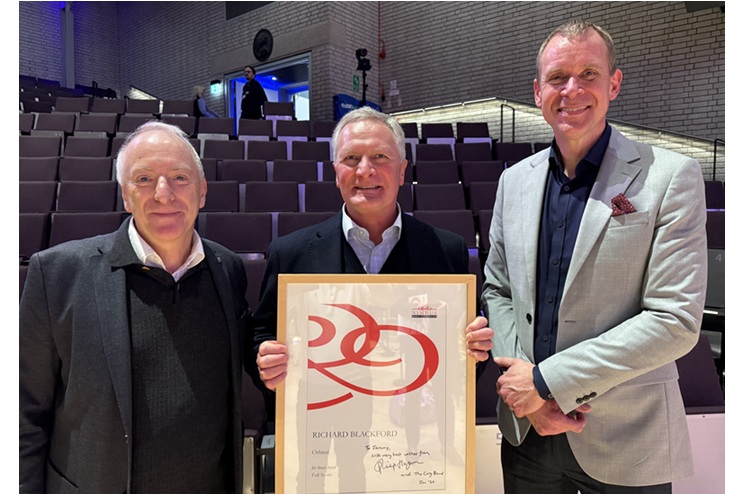
A presentation was made to the composer's brother, Jeremy, by Richard Blackford (left) and Cory Band
Conductor: Philip Harper
Soloist: Brett Baker
RNCM International Brass Band Festival
Sunday 25th January

Arguably the most anticipated world premiere performance at this year’s RNCM Festival came with Richard Blackford’s, ‘Orbital’.
Announced by Philip Harper at the 2025 event as a proposed commission between Cory, Foden’s, Tredegar, Flowers and the cooperation band alongside Radio 3 and Nimbus Music Publishing, its successful gestation period of under a year was a significant achievement in itself.
Considerable substance
Inspired by Samantha Harvey’s Booker Prize winning novel chronicling a single day in the lives of six astronauts circling the earth in the International Space Station, it left an impression of considerable substance. It will be interesting to see whose contesting orbit it circles in the years ahead.
The MDs well-attuned sense of narrative gave the compactly written score a momentum that never slackened its literary or musical tethering; the four sections displaying strongly characterised development that provided demanding challenges without becoming the stuff of sci-fi virtuosic fantasy.
The MDs well-attuned sense of narrative gave the compactly written score a momentum that never slackened its literary or musical tethering;
It was a nuanced appreciation of skilful technique balanced by an engaging melodic covering that offered a fascinating complement to Philip Sparke’s ‘Raveling, unraveling’ – also a work of lean, ensemble led exploration, inspired by engaging source material.
The composers were contemporaries at the Royal College of Music, and whilst circumstance saw them head in different musical directions, the inherent appreciation of economy of scale and acuity for meaningful structural evolution, was clearly heard in both works.
Forensic artistry
Sparke’s appreciation in search of ‘La Valse’ was an investigation of forensic artistry – variants and adaptations of deconstruction eventually brought back together in rejuvenated form. It was splendidly portrayed, richly textured in the ensemble but always with a sharp edge of precision bladed solo work.
Sparke’s appreciation in search of ‘La Valse’ was an investigation of forensic artistry – variants and adaptations of deconstruction eventually brought back together in rejuvenated form.
Authenticity
The second world premiere came with Mark Boden’s ‘Descent’ – originally written in 2018 for the National Orchestra of Wales to perform at the 50th anniversary of the Vale of Glamorgan Festival.
In three distinct parts with slightly Arabic flavourings, the textured colourings of the score were understandably more muted and less expansive than the original, but the composer’s intuitive appreciation of the banding medium (he was a cornet player with Desford) gave it a neatly conceived transferable authenticity.
the textured colourings of the score were understandably more muted and less expansive than the original, but the composer’s intuitive appreciation of the banding medium gave it a neatly conceived transferable authenticity.
Glitterball
Elsewhere, Philip Harper’s own, ‘Anno 1920’ provided the energised opener to the afternoon, whilst Brett Baker enjoyed himself on Philip Wilby’s ‘Light Fantastic’ - an affectionate portrait of ecclesiastical dance-floor ineptitude, although one very much framed by serious musical considerations.
The composer’s witty introduction set the scene, the soloist enjoying the spotlight under the cathedral glitterball.
Iwan Fox