
RNCM Brass Band
Conductors: Katrina Marzella-Wheeler; Chris Binns
Soloist: Louis Kroni
RNCM International Brass Band Festival
Sunday 25th January

The RNCM continues to provide an enviable stream of talented performers who deservedly find their way into many of the UKs top bands. As a result, a number of the current global cohort enjoyed a busy weekend of performance at the festival.
It also saw one of Switzerland’s finest young players invited to join the RNCM Band as a featured soloist for a programme that touched on inspirations of excellence - from the Olympic Games to pioneering space travel.
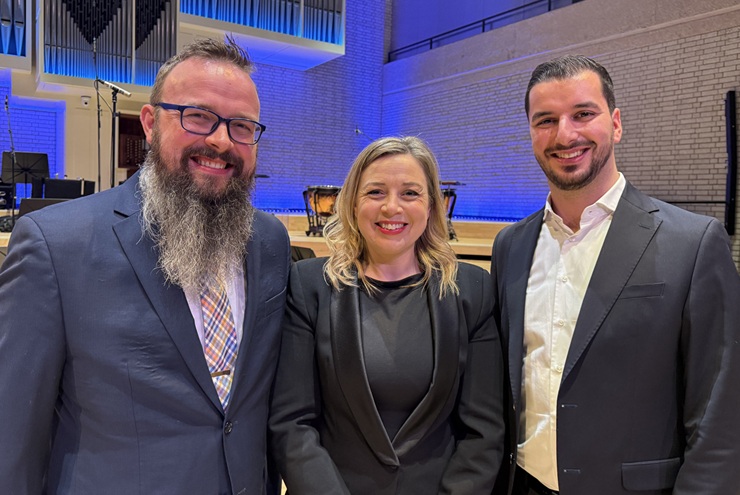
Louis Kroni (above right) is no stranger to top-flight UK banding, although at present he is part of the solo cornet bench at Valaisia. The 2025 Swiss solo champion’s fizzing rendition of his own soprano cornet solo ‘Dark of Bright?’, was a reminder that the elite level of his nation’s banding is also underpinned by an exceptional generation of talent.
Substance
The concert opened with Philip Sparke’s ‘London Overture’, a concise test of skill, nerve and substance that was used as the set-work at the 1991 European Championships in Rotterdam.
Katrina Marzella-Wheeler framed an energised account, featuring a confidently played series of tricky cadenzas before the music seamlessly developed through its modulated challenges and recapitulations.
Unlike John Ireland’s ‘Comedy’ portrait of the capital, Sparke’s ‘overture’ has no defining narrative, hidden subtext or chirpy 54 ‘Piccadilly’ bus conductor motif to form picture postcard imagery. Instead, it is simply a work structured on clear demands - all of which were met with mature aplomb.
Detours and sub-plots
In musical contrast, an amalgam of narrative detours, sub-plots and cleverly integrated quotes were to be heard as the riotous Parisian atmosphere of the opening night of Stravinski’s ‘Rite of Spring’ was brought to life.
When the French riot, as recalled with vibrancy here, they certainly do it in some style.
Unlike the Sparke, Simon Dobson’s composition deliberately obfuscates and confuses; an almost mythical recall of the gloriously messy, acerbic after-effects when musical and entrepreneurial geniuses collide. When the French riot, as recalled with vibrancy here, they certainly do it in some style.
The Right Stuff
Cool heads and analytical brains were certainly required by the astronauts that manned NASA’s Mercury space flight programme of the early 1960s. Famously referred to as ‘The Right Stuff’ by author Tom Wolfe, these were men engaged in exploration of heroic proportions.
Derek Jenkins paid personal tribute with coded ciphers, cryptography and operatic metaphor
Derek Jenkins (left of image) paid personal tribute with coded ciphers, cryptography and operatic metaphor in his short, but telling, ‘We Seven’, that eschewed the filmatic scope of rocket imagery to bring us insight to the human element (astronaut John Glenn listened repeatedly to Madam Butterfly to relax away from the confines of the capsule) that eventually led to man stepping foot on the moon.
Directed by an equally impressive Chris Binns (currently studying orchestral conducting under Mark Heron at the RNCM) it revealed its hidden meanings with subtle shifts of smooth calibration.
Adhesion
A little gem of textural writing from Theo Koita that drew two distinct halves of writing into a cohesive whole provided the listener with a very different form of aural escapism.
‘Tabi: The Journey’ was a very personal sonic journey - thoughtful and fragmentary yet still drawn together in inter-locking adhesion.
‘Tabi: The Journey’ was a deeply personal sonic journey - thoughtful and fragmentary yet still drawn together in inter-locking adhesion.
Errollyn Wallen's celebratory ‘Gold Saturday’ heralded by a nine-piece ensemble of dhol drums, Sousaphone, trombones, trumpets and clarinet, provided a meandering, mesmeric rhythmic base to close - one that bubbled in joyful intensity to round off a concert that fully delivered on all aspects of its youthful excellence.
Iwan Fox