
(Image: Copyright permission of John Stirzaker)
Conductor: Prof Nicholas Childs
Soloists: Yasuaki Fukuhara; Tom Hutchinson; Adam Bokaris
RNCM International Brass Band Festival
Saturday 24th January

An imposing display of identity power generated by Prof Nicholas Childs and Black Dyke Band sent a thrilling charge of musical electricity surging through a packed audience at the RNCM Concert Hall.
It was a reminder of the partnership’s draw-card popularity as well as desire to regain the laurels as the banding world’s pre-eminent contesting force.
There was little doubt left about the authenticity of their current potency, even on such a stamina sapping programme.
Free spirit
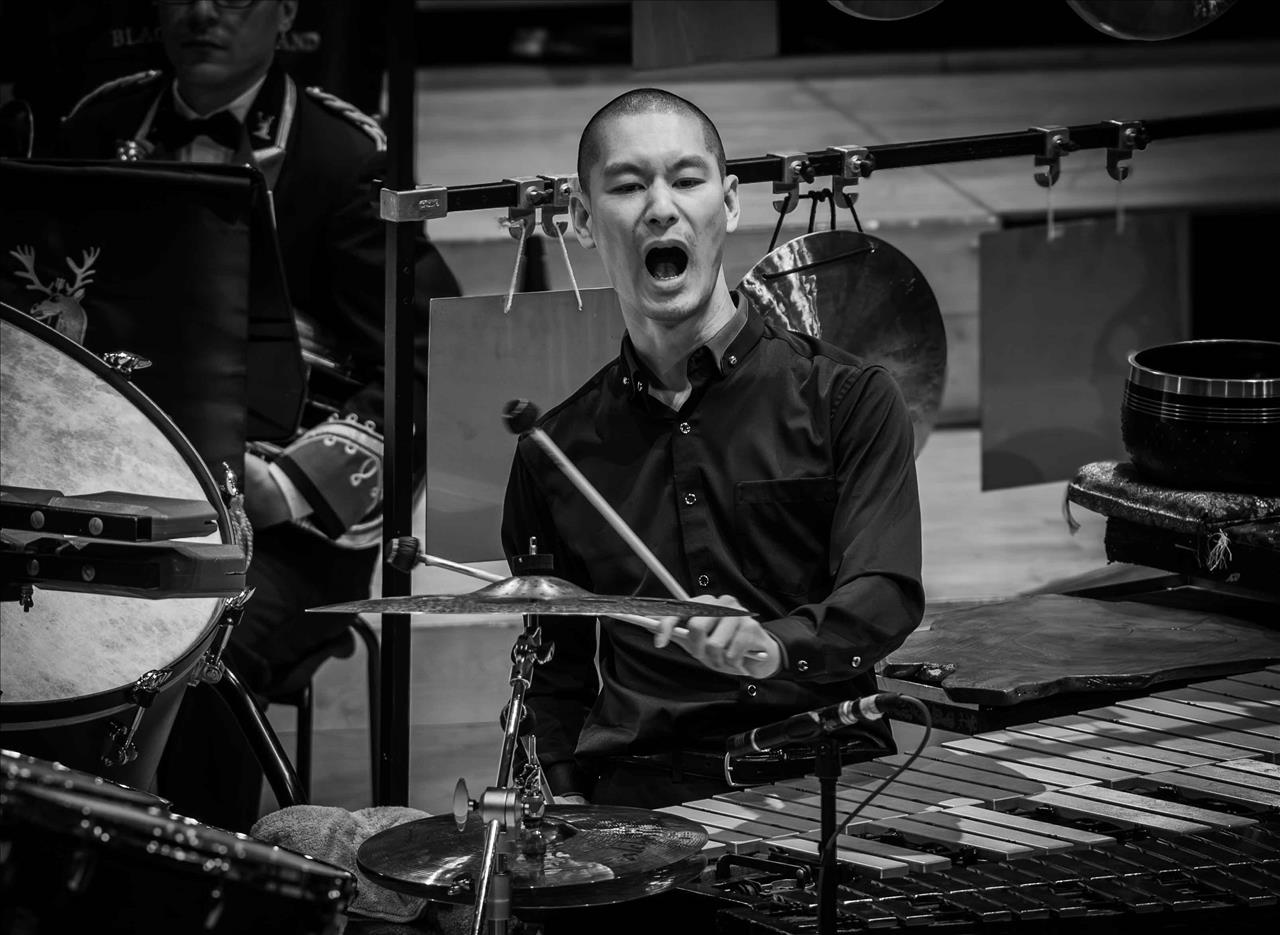
At its core came the brilliance of soloist Yasuaki Fukuhara with Simon Dobson’s ‘Percussion Concerto No. 1 Shofuku ji: The Hall of Healing’ - an enthralling, self-energised alchemy of artistry and theatre.
Despite being imprisoned in a framework cell of tuned and untuned instruments, gongs, bowls, crotales, drums, wind chimes and slabs of metal, his was the freest of musical spirits.
Despite being imprisoned in a framework cell of tuned and untuned instruments, gongs, bowls, crotales, drums, wind chimes and slabs of metal, his was the freest of musical spirits.
A mix of Buddhist discipline and artistic self-expression flowed through his body (Fukuhara is a monk in the Tokyo Temple that gives the concerto its name) - underpinning both the music (played from memory) and its interpretation; intricate rhythmic patterns and colour bandings that elicited a myriad of textures and effects, some stroked and caressed, others beaten with fierce, precision focus.
The opening movement spoke of a warrior’s heart and pride, the central section embraced the tenderness of healing, whilst the finale was a playful reminder of the joy of family. It was mesmeric – truly so. The standing ovation was deservedly spontaneous and lasting.
Capricious horror
Earlier, Paul Lovatt-Cooper’s ‘Fanfare for Bradford’ opened the evening with a familiar sugar rush fizz (as did Jacob Vilhelm Larsen’s more substantial ‘Aureum Spiriti’ for the second) that sat in contrast to Emmy award-winning composer Bruce Broughton’s very personal recall of the devastating 2025 Santa Monica fires in California.
Any inclination towards filmatic narrative was eschewed in 'Wildfire'. Instead, this was conflagration as a relentless, capricious horror, fuelled by wind and tinder dry scrubland, and no respecter of fame or fortune – the tiniest cinder capable of destroying homes as well as lives, from film stars to heroic firefighters.
Instead, this was conflagration as a relentless, capricious horror, fuelled by wind and tinder dry scrubland, and no respecter of fame or fortune – the tiniest cinder capable of destroying homes as well as lives, from film stars to heroic firefighters.
It was followed by ‘Gemini’, a new brass band version of an existing Philip Sparke wind band duet originally written for trumpet and euphonium. Oddly for a work that aims to ‘explore the close relationship’ between the instruments, the curious positioning of Tom Hutchinson and Adam Bokaris some distance apart and stood by each other’s banding seat somewhat robbed the sense of connectivity, despite the individual excellence.
Immersive
Any disappointment at not hearing the originally programmed gemstone set ‘Variations’ by Thea Musgrave was offset by the heavyweight jewellery displayed in Edward Gregson’s ‘Symphony in Two Movements’ – dark slabs of ruby red meaty sound marbled with delicate ensemble textures and solo linings.
Perhaps a year out of kilter in performance date at the festival, it nonetheless more than warranted its authoritative inclusion.
Howard Snell’s masterful arrangement of Respighi’s ‘Feste Romane’ brought the vox populi atmosphere of the Eternal City to Manchester to close.
Howard Snell’s masterful arrangement of Respighi’s ‘Feste Romane’ brought the vox populi atmosphere of the Eternal City to Manchester to close.
Totally and thrillingly immersive, it was superbly directed and performed – from the visceral excitement of Nero’s ‘Circus Maximus’ and the certainties of Christian pilgrimage in ‘Il Giubileo’, to the autumnal reflections of ‘L’Ottobrata’, and sparkling, orgiastic celebrations of ‘La Befana’.
No wonder everyone left exhausted, fully satisfied by the night’s musical explorations.
Iwan Fox