
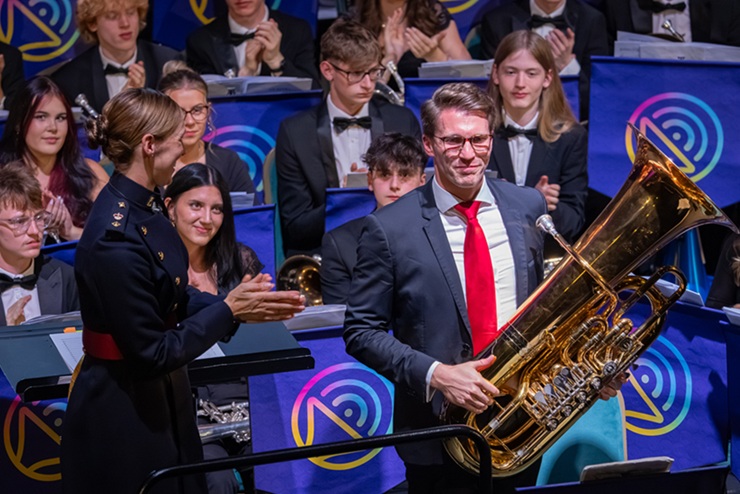
(Image: Marc Gascgoigne Photography)
Guest Conductor: Lt Col Lauren Petritz-Watts
Assistant Conductor: Tommy Tynan
Soloist: Ross Knight
The Forum, Bath
Saturday 8th August

Classical music composers have long been pioneers of the recycling movement. From Bach to Wagner, motifs and even whole pieces have found a secondary life repurposed in new packaging.
Others too. Never mind Mike Batt and the 1970s green activist Wombles of Wimbledon – quite a few of the current banding world’s most respected figures make repeated ‘good use’ of the original themes of inspiration they find.
Multi-purpose
The ethos of this year’s NYBBGB course - ‘Reduce, Reuse, Recycle’ therefore had a multi-purpose relevance for the 90 plus Gen Z musicians on stage – youngsters fully aware of the issues surrounding the global cost of consumption driven consumerism, especially through cheap high street fashion.
There was an understandable passion then that drove the world premiere of Simon Dobson’s ‘MACHINE!’ – although one that spelt out its message with startling originality.
the metamorphosis of the huge chords of material fed by the composer into his steam-punk machine seeing it reduced to elemental threads of colour, beauty and texture ready to be reinvented with new optimistic purpose.
It’s thought-provoking musical imagery underpinned the explorations of the technological drive to sustainable reinvention - the metamorphosis of the huge chords of material fed by the composer into his steam-punk machine seeing it reduced to elemental threads of colour, beauty and texture ready to be reinvented with new optimistic purpose.
This was achieved thanks to Lt Col Lauren Petritz-Watts’ calm authority in drawing both technical composure and wide-ranging musicality from the players – something that was already evident from the opening ‘Ad Astra’ that sparkled brightly even in a rather boomy concert hall.
Mature appreciation
So too the mature appreciation displayed (especially the main solo lines) with Martyn Brabbins’ ‘In Memoriam: E.H.’ – an emotive cameo tribute to his friend and inspiration, Elgar Howarth.
Here the reused motifs had a telling depth of meaning; the opening figure Howarth’s own, first heard in his early work ‘Mosaic’ as well as on his memorial tribute to Rudolph Kempe.
Here the reused motifs had a telling depth of meaning; the opening figure Howarth’s own, first heard in his early work ‘Mosaic’ as well as on his memorial tribute to Rudolph Kempe.
A nod of appreciation to Harrison Birtwistle saw the music grow from hymnal eloquence to quirky inquisitiveness before settling with an imposing Zarathustra climax.
Superb artistry
A fine communal understanding was also shown in accompanying the Vaughan Williams ‘Tuba Concerto’, played with superb artistry by soloist Ross Knight. It was a vibrant account that belied its age, its originality still fresh and engaging.
the Vaughan Williams ‘Tuba Concerto’, played with superb artistry by soloist Ross Knight. It was a vibrant account that belied its age, its originality still fresh and engaging.
He later returned for a fleetfooted ‘Quicksilver’ and a stunning piece of virtuosity in his solo encore ‘Fnugg’ that would have been impossible to replicate even by the cleverest far east fashion brands.
Makeover finale
Contrasts of solo expression and ensemble exuberance were drawn by Assistant Conductor Tommy Tynan’s shaping of Liz Lane’s ‘Serenata’ and Ashley Marston’s ‘Echoes of Youth’, before Lt Col Lauren Petritz-Watts tested ambition and stamina with Johan De Meij’s imposing ‘Extreme Make-over’.
True to the course theme, the reduced themes (from Tchaikovsky’s ‘String Quartet No.1’), reused motifs (everything from his Fourth and Sixth symphonies to ‘1812’ overture) and recycled effects (water-tuned bottle flutes) made for the most appropriate of finales – packed with solo and collective endeavour in its repackaging from opening simple beauty to overwrought bombast to close.
The encore of Philip Wilby’s thoughtful modification of ‘The Day Thou Gavest’ was a most fitting way to end.
Iwan Fox