
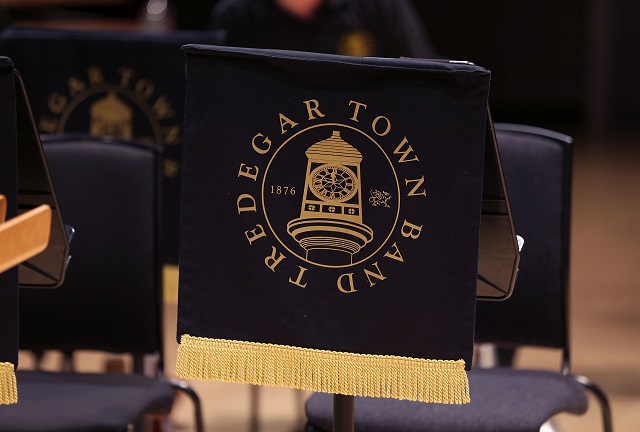
Conductor: Ian Porthouse
Soloist: Glenn Van Looy
RNCM International Brass Band Festival
Saturday 24th January

The Welsh champion’s visit to the RNCM Festival invariably sees them bring intriguing repertoire for audiences to enjoy.
This year was no exception, with a trio of deceptive musical portraits that despite being notoriously unreliable indicators of character truthfulness, made for thoroughly absorbing studies of compositional inspiration.
Endorsement
Philip Sparke’s ‘Land of the Long White Cloud’ was a case in point. Written in 1979, it was used at the New Zealand National Championships the following year.
From then on it has gained a narrative linked to the country’s landscape, history and genealogy, yet as the composer has himself reaffirmed, it is anything but – the most obvious caveat being the complete lack of personal foreword.
What Tredegar firmly endorsed was that it was early Sparke at his vibrant best – the rhythmic complexity of the surging opening followed by seamless transitions of majesty, playful dance and languid blues before a reprise and waspish finish.
What Tredegar firmly endorsed was that it was early Sparke at his vibrant best – the rhythmic complexity of the surging opening followed by seamless transitions of majesty, playful dance and languid blues before a reprise and waspish finish.
The mind’s eye may still wander to a far away land, but the reality played with glorious reality under Ian Porthouse, was much closer to home.
Dayglo coloured
So too with Phil Lawrence’s ‘Mellisande’ – a portrait of a day in the life of a much-loved family dog, although one not blessed with the symbolic temperament of Debussy’s doomed lover.
Instead it seemed to be infused by the DNA of the anarchic ‘Roobarb’ in the dayglo coloured 1970s children’s television series, trained under the guidance of Hans Werner Henze.
Instead it seemed to be infused by the DNA of the anarchic ‘Roobarb’ in the dayglo coloured 1970s children’s television series, trained under the guidance of Hans Werner Henze.
It was wonderfully acerbic in its dark wit and clever connective illusions though (like Debussy’s heroine, the dog peers into waters full of goldfish at one point looking for something lost), REM dream-twitching and boundless energy.
Breathless in technique yet tender in lyricism, it was a canine let off the leash to enjoy a densely scored forest of inventive adventure -although you suspect not too often. Even a band of Tredegar’s much admired musical resourcefulness needed a rest at its close.
Masterful taming
Derek Bourgeois was also blessed with adventurist inclinations, matched only by his own sardonic wit and fearless compositional demands.
At times it got the better of his music, but with his ‘Euphonium Concerto’ performed by Glenn Van Looy, technical dictates and acidic humour were tamed by the masterful command of a true world class brass band performer.
with his ‘Euphonium Concerto’ performed by Glenn Van Looy, technical dictates and acidic humour were tamed by the masterful command of a true world class brass band performer.
Written in 1990, its massive opening movement became an emboldened display of controlled power technique, contrasted by a central Lento con molto, that drew impassioned melancholic depth from the soloist. The finale, a romp of high range exuberance was delivered with flourish of finessed brilliance.
Earlier, the concert opened with a neatly rendered miniature in Tamsin Crook’s ‘A Spark Forgotten’.
There was no connective portraiture to the festival composer, yet he would have fully identified with the mature structuring (written when she was just 17) that drove the music forward to its bold, dramatic climax.
Iwan Fox